As I was up late I decided to take part in the 0-hour game jam: a challenge to make a game in the hour gained when the clocks go back.
It was impromptu and entirely unplanned so the final game is a result of listening to Lustmord at 1:00am, combined with some floaty uncontrollability inspired by a dream I had. The original goal was to have an Antarctic environment based on the trek in At The Mountains of Madness, but this soon shifted to a more abstract dream world when it dawned on me just how quickly an hour passes.
I spent another half an hour or so polishing it off and fixing up the code a bit.
The audio was sourced from Freesound.org: here and here. The first-person character controller is the Unity prefab with tweaked jump and movement parameters.
I removed this post last year, and decided to re-post it for the sake of completeness. It has a new date stamp now, but you can see from the comments' date stamps that it's quite old! Ahh, those were the days.
Luminesca is now, of course, a fully-fledged project in development.
Original post:
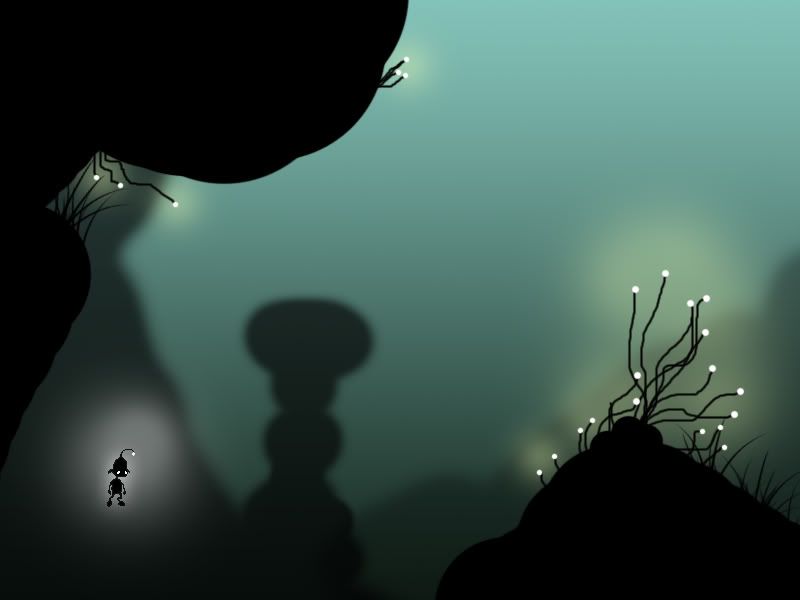
I've been toying with the idea of an updated Luminesca game, and came up with this mock-up screenshot. All comments and criticism are more than welcome!
This small yet cloying sample of The Binding of Isaac is an admittedly incomplete experience of the game, but due to its procedurally-generated nature there is no such thing as a complete picture; only random cross sections cut at unpredictably obscure angles.
The game is reminiscent of the 8- and 16-bit Zeldas in its mechanics, enemy design and level design, although dungeons are made up of never-the-same-twice rooms and the whole thing is draped in a nightmarish basement aesthetic loosely inspired by an ancient story about child sacrifice.
The Binding of Isaac almost overcomes its lack of melee combat by compressing the ranged attacks to just the four cardinal directions, placing additional importance on aligning yourself with your targets either horizontally or vertically, and complicating this process using various static obstacles (such as piles of degrading faecal matter). When enemies close in on you it is possible to move and shoot in different directions, but I did encounter the odd occasion where the available space was too confined, the enemies advanced too quickly and my fire rate was simply too slow. Randomisation has its drawbacks.
Its fictional premise is unique compared to most games and the intro cinematic was certainly entertaining, if a little overt in its Biblical themes, but I sense that it takes the Shadow of the Colossus / Metroid approach of using cinematic sequences to merely bookend the lengthy action part of the story. That is to say it opens with a 'premise cinematic', lets you spend a very long time doing stuff in response to that premise and closes, when you reach your goal, with a 'job done cinematic'. I may well be wrong (please correct me if I am), but that's how it appears from the demo. It's an effective enough structure (and has been touched upon here) but does leave the bookends feeling like exposition overkill when the rest of the game's narrative is delivered so sparingly.
For all its flaws (which I tend to dwell on when I deconstruct a game) Isaac is a shining example of a top-end indie game which demonstrates a strong understanding of the challenges presented by overhead camera angles in 2D games.
It's dirt-cheap on Steam (with soundtrack available too) and the free demo is playable in your browser on Newgrounds.
I've been intending to play Rocket Knight for a long time and finally got round to it today. It's a solid game which knows what it's about. It clearly understands what makes a good 2D platformer and has some interesting level design in certain sections.
The Cyberswine Labs level provides a great example of folded level design. A 'fold' in the level occurs when the player has to backtrack through areas they have already visited. While backtracking can easily become tiresome if those areas are now empty and devoid of challenge, a folded level can retain interest by changing the way the player interacts with the environment the second time through and providing challenge variation. A folded level can be broken down into "the way there" and "the way back". The way back often provides the more difficult or complex gameplay.
In the example in the video above Rocket Knight has to ride the moving platforms down through a maze of dangerous energy beams. As the platforms lower the player must Rocket Burst between them to avoid the beams. On the way down gravity is on the player's side so they can simply fall down on to the next platform as they drop below.
The Rocket Burst ability forces the player to commit to moving in a fixed direction and is restricted by their fuel supply (which is limited in the ice level). But it doubles as a fast attack and is the strongest tool the player has to defy the platform game's most persistent obstacle: gravity.
However, when the level folds (when the player hits the switch at the bottom and reverses the direction in which the platforms move) the player has a new layer of difficulty added to the challenge. Because the platforms are now moving up, the player has to fight against gravity to keep up with them by jumping as well as Rocket Bursting in a test of precision timing at a fixed pace.
A second overarching fold occurs in full glory during the dramatic escape sequence at the end of the level. Rocket Knight destroys the laboratory core, setting off a massive explosion which constantly swells in size. The player must now backtrack through the entire level with the explosion hot on their tail (literally -- Rocket Knight is an opossum). So the way there features all the standard level design features and challenges the player is used to in the game, while the way back entails a test of speed and precision timing, as well as a slightly modified path to allow short-cuts and less stilted movement through the level. The whole thing now mostly takes place above a bottomless pit, meaning the constant force of gravity is always working against the player.
After the second fold, most players will probably race back through the aforementioned 'moving platform energy beam room' so quickly that they won't even realise they've passed through it twice before. Thankfully, the beams and platforms have now deactivated so Rocket Knight can burst freely and bounce off its walls at great speed.
Through this smart level design, Rocket Knight gets extra mileage out of its restricted space (as nearly all game spaces are restricted) without ever becoming repetitive or tedious.
It's time for an update, seeing as I haven't done a proper one in over a year. I've been very busy since then with all this stuff...
I graduated from UEL last year and got a First for my efforts. Hooray! This was largely thanks to my dissertation which you may remember I talked about on this very blog at the time. That dissertation is now freely available for you to read in my portfolio (mglanville.co.uk). Hopefully it will help out anyone who is writing their own dissertation and maybe even interest people generally interested in level design.
After I finished university I landed a job at EA Bright Light where I worked on Create and Harry Potter and the Deathly Hallows: Part 2. My first job in the industry was an awesome experience and it has equipped me with a good understanding of game development to take forward into future projects.
Now my contract has ended at Bright Light and I am spending my time working on Luminesca (which you might also remember me mentioning on this blog). I'm trying to gain crowd funding for the project through IndieGoGo, so head on over and take a look, and if you like it please consider donating (any amount)!
As well as all this I've tried to squeeze in some gaming time here and there. Highlights that spring to mind from the past year have been:
Battlefield: Bad Company 2 (big multiplayer battles, but not too big)
ilomilo (I love games that play with space in simple yet profound ways)
Lara Croft and the Guardian of Light (best co-op since Left 4 Dead)
Machinarium (charming little adventure and a perfect length)
Portal 2 (sublime writing)
Talesworth Adventure Episode 1 (solid little adventure with no frills)
Finally I should mention an excellent game design blog I stumbled across earlier this year called Critical-Gaming Network. There's a lot to read, but it's well worth it, so get started now! Start with the Courses 101-6.
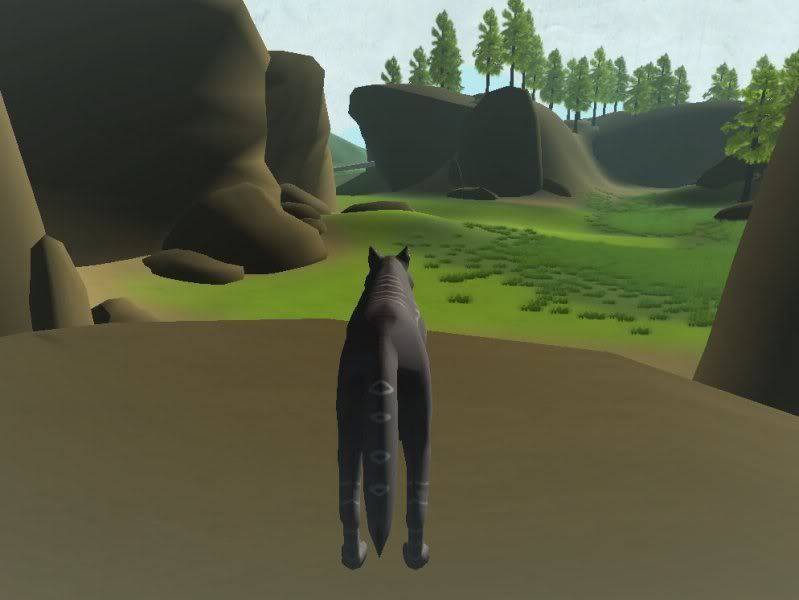
Making progress on the wolf game for the university group project! I got my rock and cliff models up and running in Unity and implemented them into the terrain I made, using Habboi's style guide and player model. I'm pleased with the models I created and they seem to be pretty versatile; I was able to rotate and scale them to create lots of different variations so there isn't too much repetition in this natural environment.